By Aku Nikkola, editor-in-chief, Tekoälyfoorumi
In brief
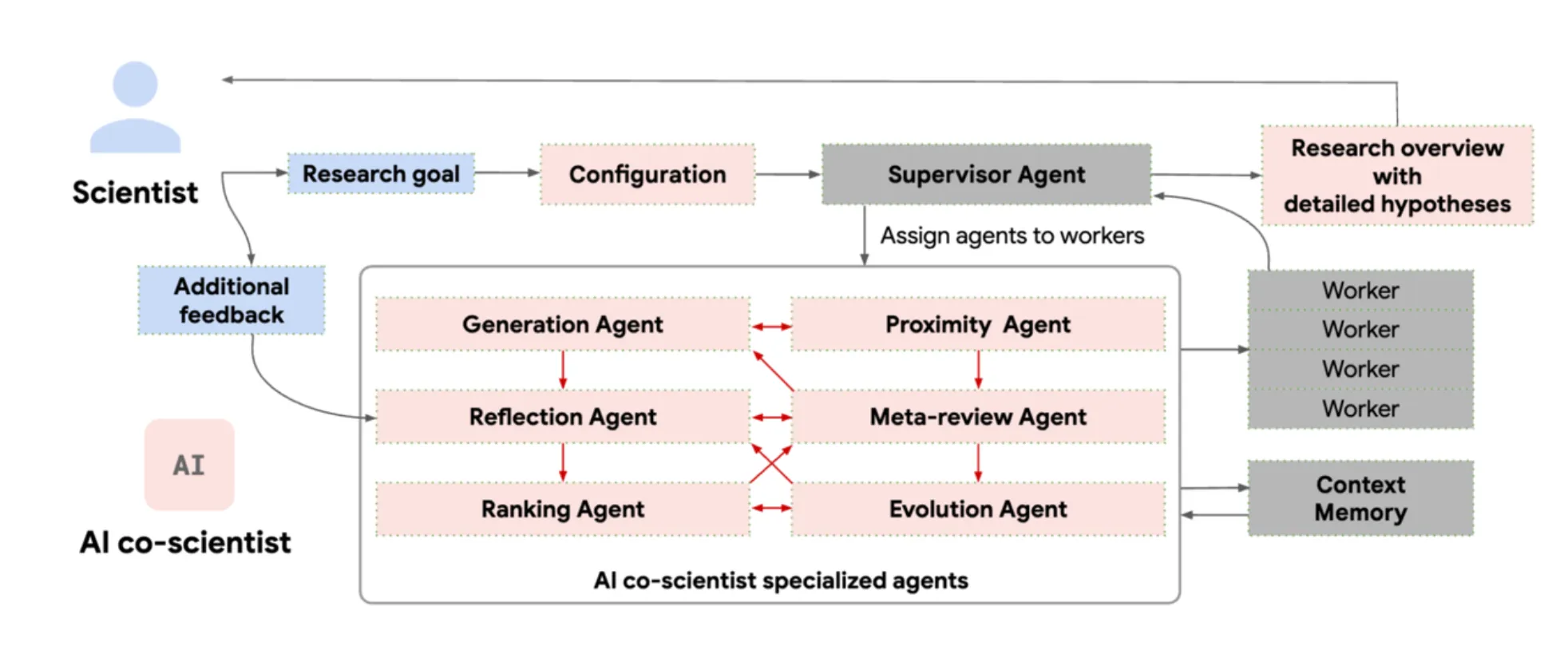
Google DeepMind has developed the AI Co-Scientist system, which works like a parallel science team alongside a researcher, made up of several AI agents specialised in different tasks.
The system produces and refines research hypotheses through an iterative process in which different agents generate ideas, criticise, and refine proposals like a panel of scientific experts.
In a test case, the AI system solved a research problem about the spread of genetic elements in two days, where a research team had spent ten years on the same thing.
The AI did not merely reproduce an existing finding but also generated new research directions, demonstrating its capability in advancing scientific work.
The system could significantly speed up scientific work, but it also raises questions about ownership of research findings and the role of human researchers, particularly in ethical judgement.
The studies referred to in this piece can be found here (the AI co-scientist paper, the gene transfer discovery paper, and the transfer re-discovery paper).
How Google’s AI Co-Scientist works
Google DeepMind has released a multi-agent AI system called AI Co-Scientist, designed to work as a parallel “science team” alongside a researcher. In this piece we’ll call the system the AI Researcher.
The AI Researcher’s process resembles peer review, in which the best-argued hypothesis becomes the “lead hypothesis”. Crucially, the system goes through an iterative cycle: it keeps improving its proposals until a sufficiently clear, testable research idea emerges.
In other words, it does not settle for a one-shot answer; its task is to refine several hypotheses through a staged process. In practice this means the AI Researcher consists of several agents responsible for critical tasks in the research process, for example:
A generator produces research topics or questions.
A critical evaluator screens and improves these proposals through a scientific “debate method”.
A ranking agent compares all the ideas produced in a “tournament”, selecting the best-argued ones to go forward.
A developer refines the winning hypotheses further, using new literature searches, for example.
These AI agents discuss and compete with each other like a panel of scientific experts. According to Google, the tool’s primary aim is to speed up or improve research: AI can find potential solutions and new questions considerably faster than human researchers alone. Alongside the AI Researcher, the role of human researchers lies particularly in validating and testing results and in ethical judgement — dimensions the system cannot handle autonomously. At least not yet.
The AI Researcher was tested extensively at the heart of an extremely multi-dimensional and challenging piece of research, in which scientists from Google Research and Imperial College London gave it a research question about the spread of genetic elements between different bacterial species. The results and observations follow.
AI succeeded in two days at what had taken a research team 10 years
For a decade, the research team had been puzzling over the ability of genetic elements called cf-PICIs to move from one species to another, and only laborious laboratory experiments revealed how the elements manage to “hijack” a tail from a bacterial virus and use it to conquer new host cells.
The team’s significant finding was kept from the AI Researcher, though, because the test was intended to find out what conclusion Google’s system would reach on the basis of publicly available information alone.
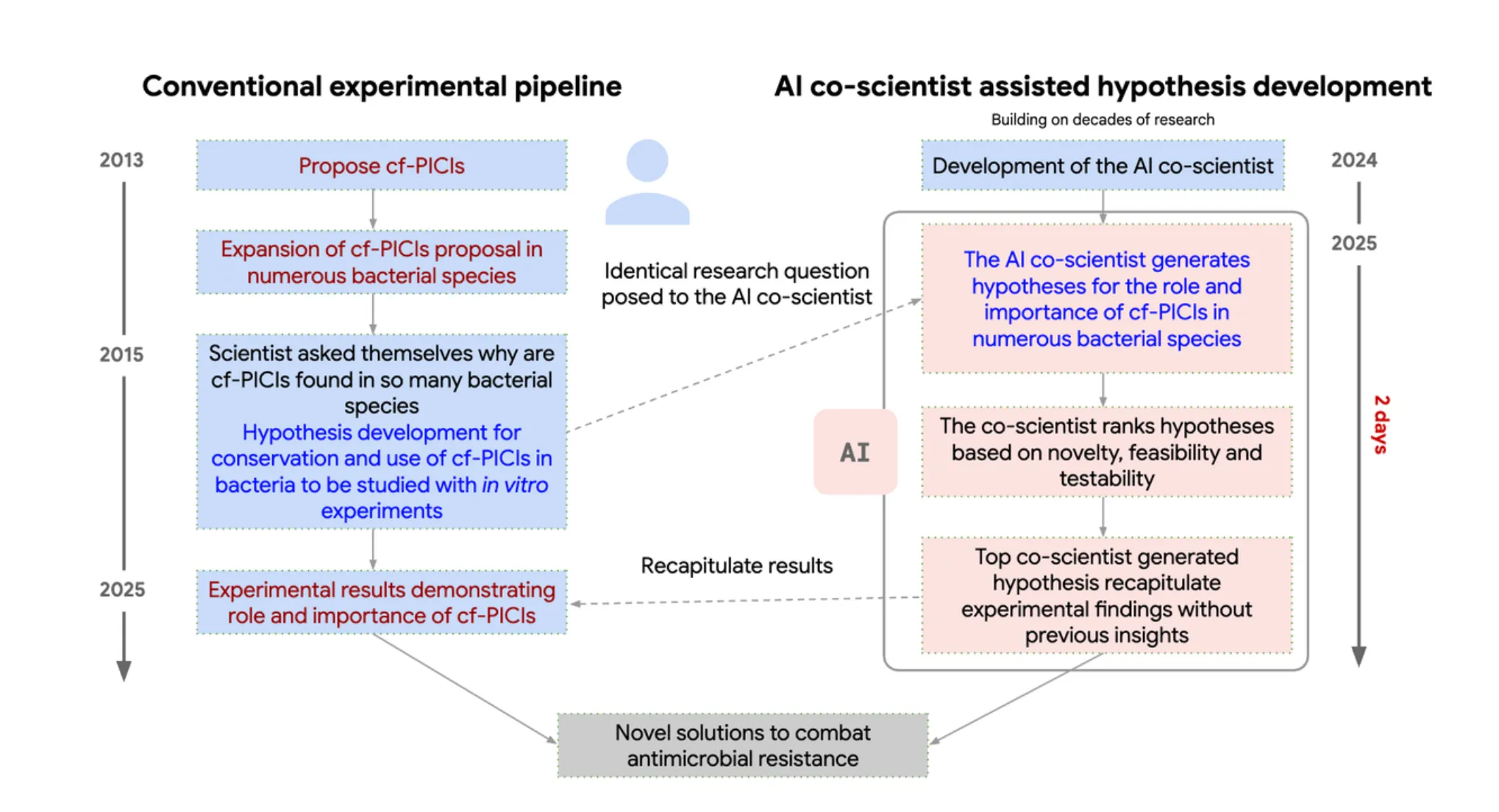
The outcome can be regarded as at least a significant demonstration of AI’s capability in research work. The AI Researcher solved the same problem, using information gathered from public sources, in two days. Perhaps more significant still, the hypotheses it produced were not limited to reproducing the existing finding — although that in itself would have been a notable result, given that the finding was unknown to it. According to the researchers, some of the proposals opened up entirely new research directions: the system suggested, for example, that cf-PICI elements might also transfer via conjugative processes. That has not yet been confirmed experimentally, but the researchers consider the idea promising enough for further study.
AI in research – how significant a breakthrough for science could Google’s AI Co-Scientist be?
In a Bloomberg interview about the release, it was noted that doing research with AI is no longer merely sifting traditional data. It actively seeks to produce and polish hypotheses like an experienced researcher. According to many specialists, this development could transform researchers’ work, speed up discoveries, and open up new ideas that people would not have come up with alone.
At the same time, questions arise about ownership: who gets the credit if AI formulates the theory that produces the final breakthrough? And can AI lead people down blind alleys if its evaluation process weakens? The team emphasises that human researchers still have the last word — within both ethical and scientific limits.
In any case, the researchers see the future of AI-assisted research as bright — AI has a significant role in research. If the AI Co-Scientist concept becomes widespread, they believe it could save enormous resources and bring a “massive leap” to science — exactly as the solving of the cf-PICI mystery, ten years’ work done in two days, demonstrates.
Links and sources
https://research.google/blog/accelerating-scientific-breakthroughs-with-an-ai-co-scientist/
https://storage.googleapis.com/coscientist_paper/ai_coscientist.pdf
https://www.biorxiv.org/content/10.1101/2025.02.11.637232v1
https://storage.googleapis.com/coscientist_paper/penades2025ai.pdf
Enjoyed this piece? Subscribe to get notified about new Tekoälyfoorumi articles straight to your inbox. We’d also hugely appreciate it if you left us a review on Google. Thank you. 💙