In brief
Finnish media houses use AI in varied ways: Viestimedia’s Renki has made editorial work 20% more efficient, Alma Media uses almost 20 AI tools, and Yle’s YleGPT works as a personal assistant for journalists.
AI has challenged old assumptions: Iltalehti’s sentiment analysis tool has shown that positive, useful content brings in more subscriptions than negative news.
Going international is easier with AI: A-lehdet translates its content into English, and Yle serves speakers of other languages with news in several languages.
Reader services have diversified: TM Tuuma answers readers’ questions, news summaries offer information quickly, and AI reads the radio news on Bauer Media’s channels.
AI works as a tool that makes journalistic work more efficient, but final responsibility for the content stays with people — nearly every application emphasises human–machine collaboration.
On 13 March 2025, the trade magazine Suomen Lehdistö published a comprehensive survey, “We listed the most interesting AI solutions in Finnish newsrooms”, mapping the use of AI in Finnish editorial teams. In this summary for Tekoälyfoorumi we look at how Finnish media houses use AI in journalistic work and in improving the reader experience.

AI making editorial work more efficient
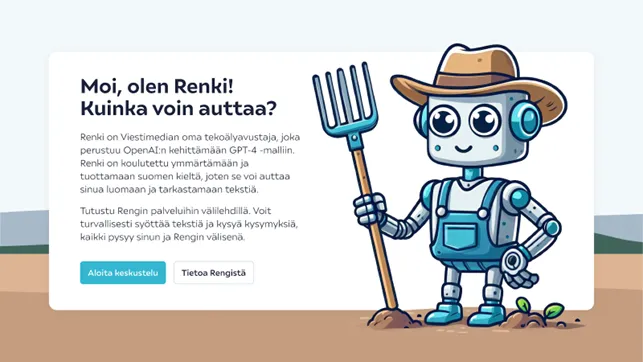
Viestimedia has gone particularly far in its AI development; its Renki tool already includes 25 different functions. Viestimedia estimates the tool has made editorial work 20 per cent more efficient measured in time. Renki helps with proofreading, drafting social posts, and story ideation, and even analyses a story’s subscription potential. Next in the development pipeline is a feature that tells you whether a story should go behind the paywall or not.
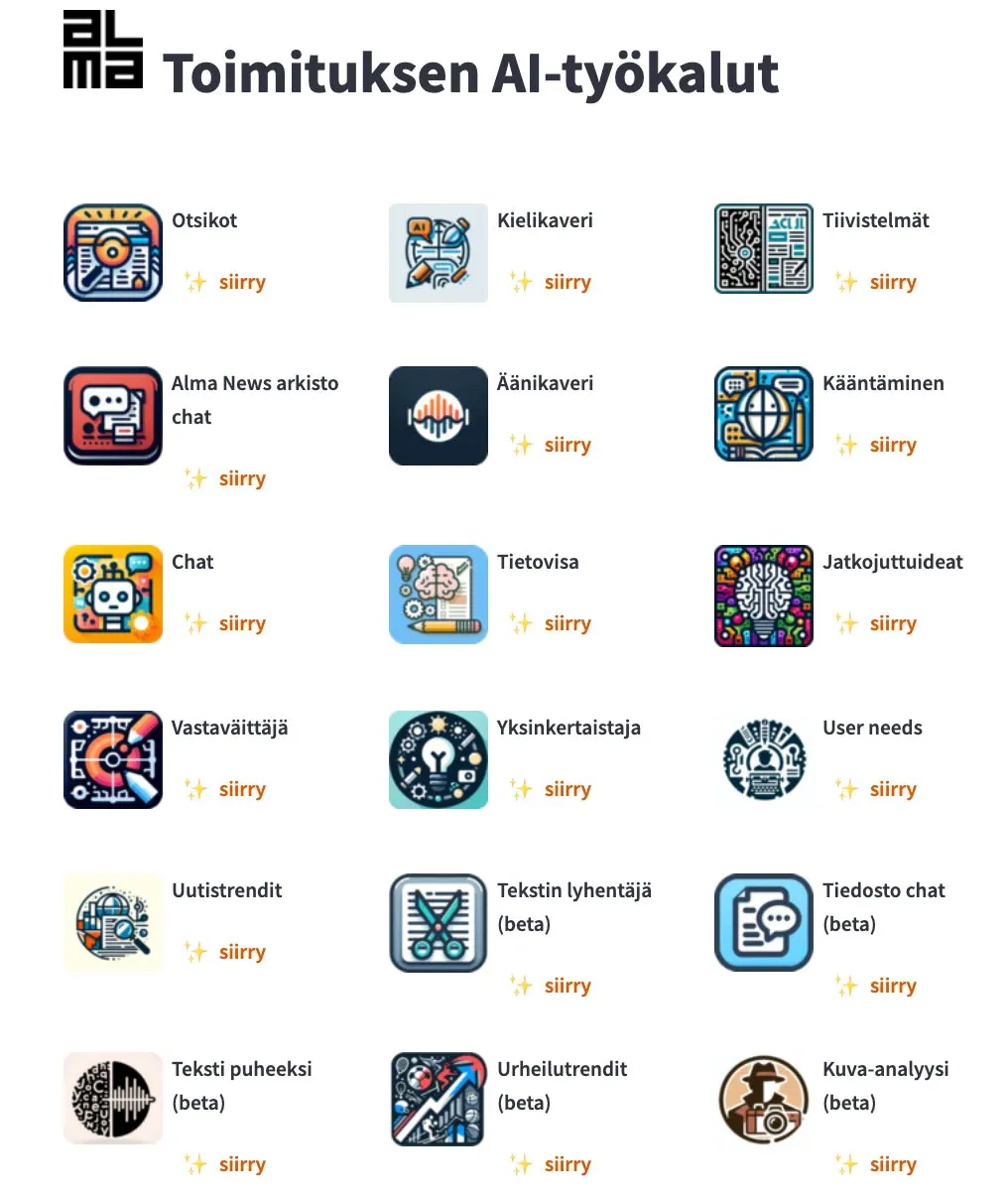
Alma Media’s newsrooms use almost 20 AI tools. The most popular are a headline tool, a transcribing “audio buddy”, and a proofreading “language buddy”. The headline tool used at Iltalehti and Kauppalehti first creates 20 headline options for a story, from which the journalist can pick the best.
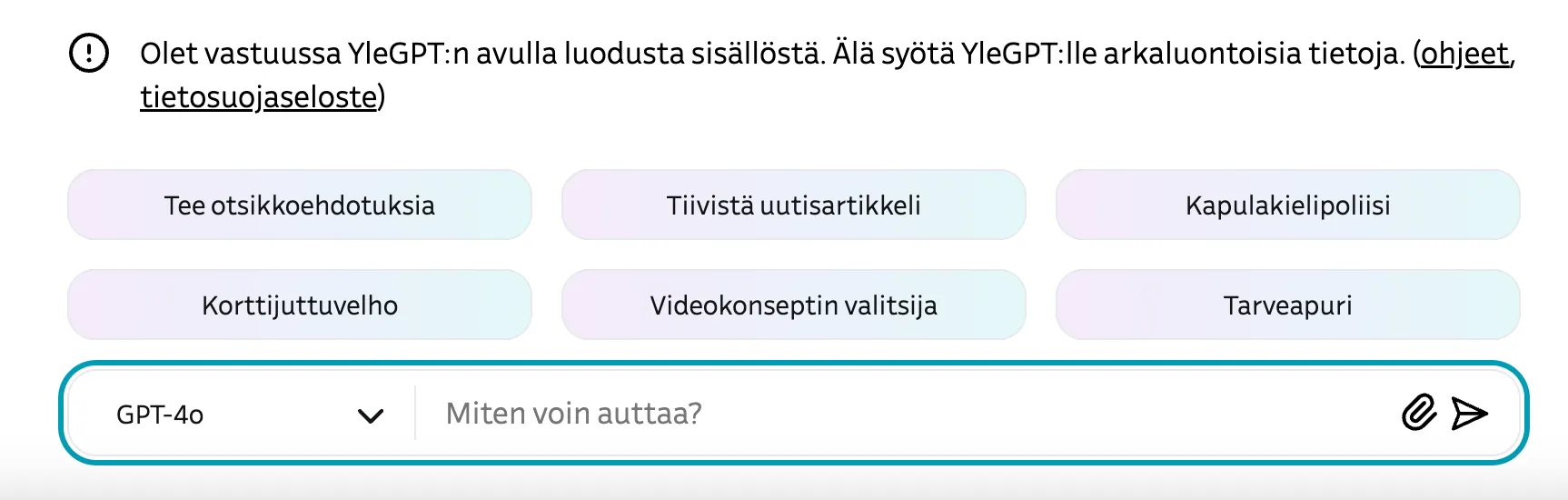
Yleisradio’s YleGPT is a personal AI assistant for everyone at Yle. Just under half of Yle’s journalists use it weekly. The most popular of YleGPT’s assistants is the Jargon Police, followed by headline generation and third the Card Story Wizard, which helps with storytelling.
From sentiment analysis to automation
One of the most interesting applications is Iltalehti’s sentiment tool, which analyses the headline and subheading of a story to work out what emotional state it is likely to produce in the reader.
According to data Iltalehti has collected, inspiring articles engage subscribers best — of the readers who subscribed off the back of such articles, only half cancelled within the following six months. Useful and constructive stories also proved the most effective at winning new subscriptions relative to their readership. These findings have helped challenge the industry’s traditional assumption that only negative news sells.
At Sanoma’s news media, AI has been harnessed as a “watchdog” that monitors various sources, such as municipal decision-making documents, and flags potentially newsworthy items to newsrooms. The watchdog tool has found stories that would otherwise have gone unnoticed.
Bauer Media, meanwhile, has focused on automating radio news content with AI. Together with the news agency STT, Bauer Media has cloned its innovation director’s voice for the radio news. STT produces easily readable news items that AI reads out on Bauer Media’s 11 radio channels. Audience research finds that over 80 per cent of listeners consider the AI voice suitable and credible for news.
Going international and journalism across language boundaries
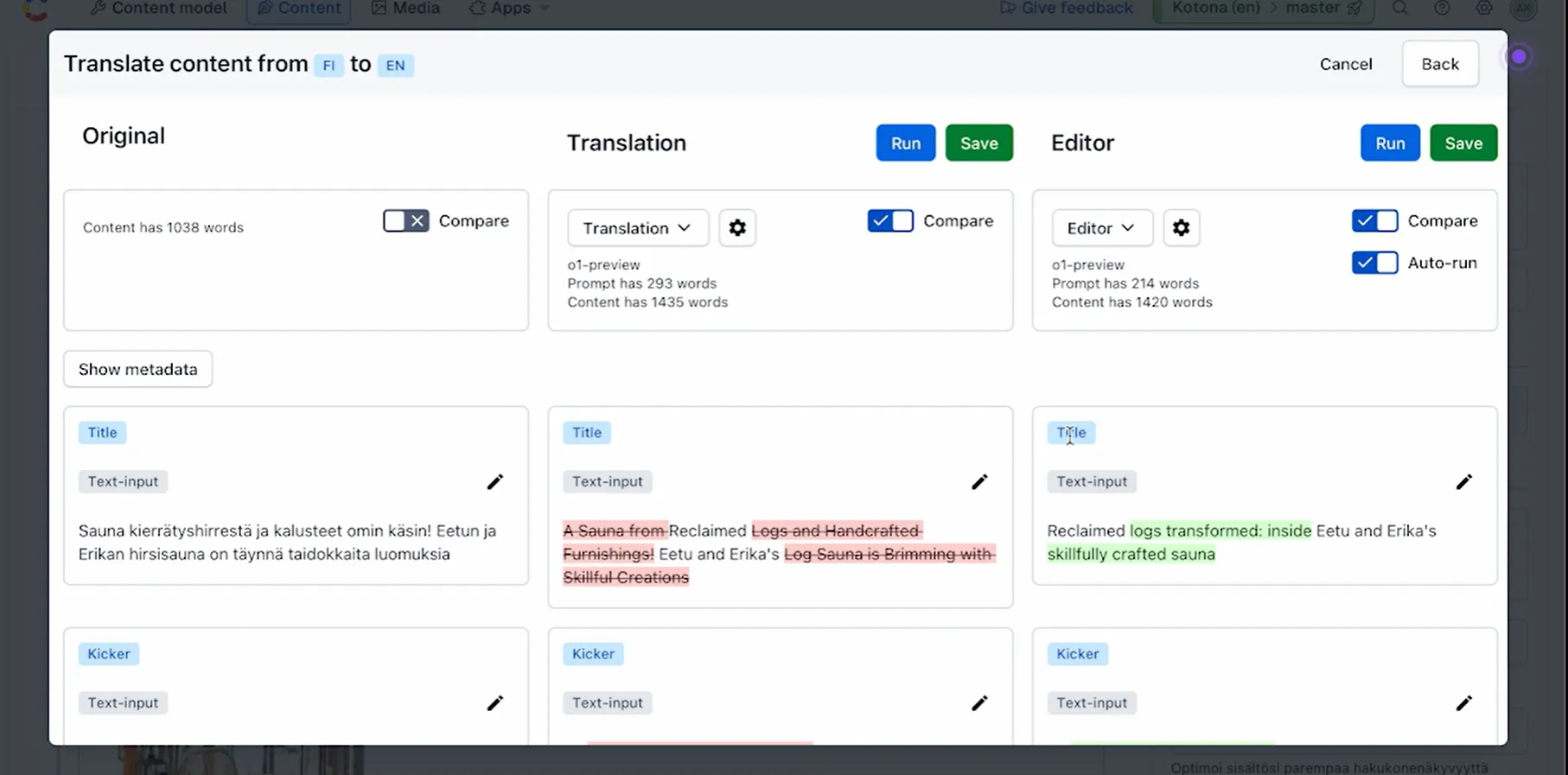
A-lehdet has used AI in going international. Its English-translated Kotona.com site is an opening into a new market. The AI does not merely translate text from Finnish into English but also adapts the style to English, changing punctuation to match the language’s conventions, for example.
Yle serves speakers of other languages living in Finland with its subtitling and translation tools, which allow Finnish-language news videos to be subtitled in Ukrainian, for example, and articles to be translated into various languages.
AI applications serving readers directly
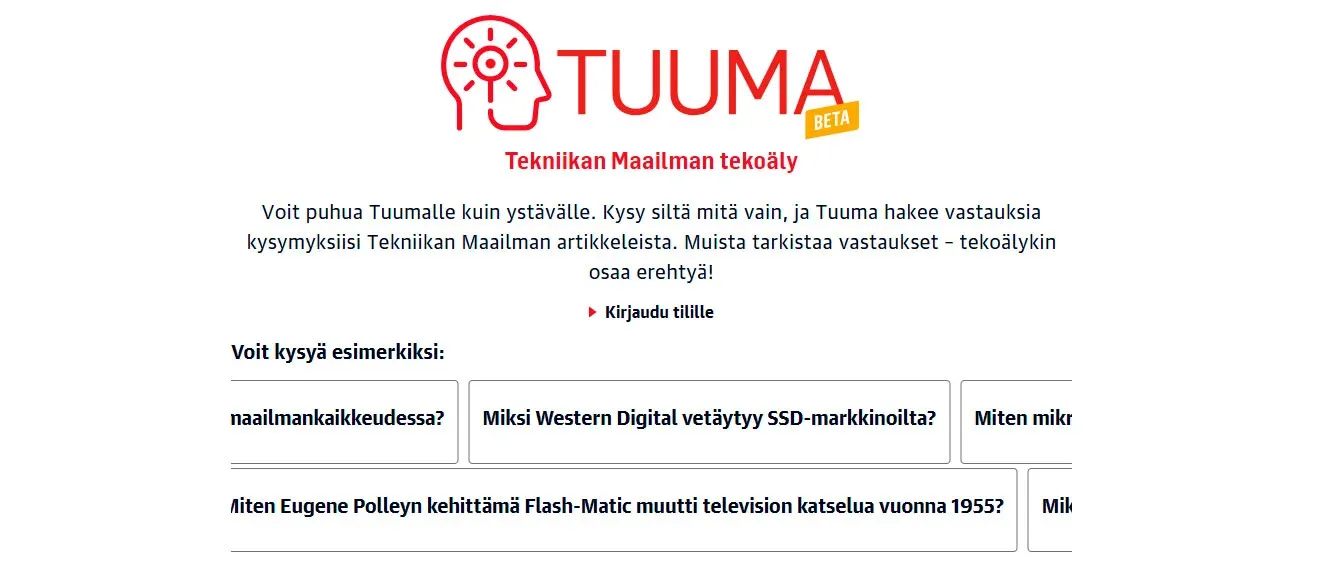
AI is also used in applications that serve readers directly. Tekniikan Maailma’s TM Tuuma answers readers’ questions on the basis of what the magazine has published over the past seven years or so. It can, for example, tabulate the specifications of two car models for comparison.
AI has also proved effective at condensing news content. At Sanoma’s news media, AI creates summaries of stories’ main points, on the basis of which Helsingin Sanomat has begun publishing a continuously updated audio digest. For certain reader groups, being able to get the information quickly is especially valuable.
Alma Media has developed a quiz tool for creating quizzes from articles. A journalist can feed an article into the tool, which creates a quiz, or generate a news quiz from a chosen Alma brand’s content within a set period and theme.
AI as a content producer – from experiment to mainstream
For two years, the magazine Tekniikka&Talous has published columns written by different language models, in which the AI is left to reflect on subjects independently on the basis of light instructions from a journalist. Texts from Google’s Gemini model are published entirely unedited. Surprisingly, these AI columns attract roughly the same readership as human-written ones, although readership is fairly small in both cases and depends most on how interesting the subject is.
This local experiment is part of a wider development. According to technology specialist Alasaarela, more than half of online content was AI-produced in 2024, and this year the forecast is as high as 90 per cent. Media companies’ biggest challenge now is to stand out from the mass with quality content — whether behind it is a human, an AI, or a considered collaboration between the two.
In summary: AI has become an established part of editorial work
Finnish media houses’ experiences with AI are largely positive. AI is seen as a tool that makes journalistic work more efficient and more varied, not as a threat that would replace journalists. Nearly every AI application emphasises human–machine collaboration: AI produces a basis that a human refines and oversees.
It is also significant that AI has helped challenge old assumptions about journalism. Iltalehti’s sentiment analysis tool has shown, for example, that positive and useful content can be more commercially viable than negative news.
The Suomen Lehdistö survey shows that AI has been integrated into Finnish newsrooms broadly and in many respects successfully — from transcription and proofreading to story ideation and distribution. Although progress has been fast, we are still only at the early stages of AI use in Finnish journalism. In future we will see increasingly personalised, adaptive, and varied AI solutions for the benefit of media companies and audiences alike.
Links and sources
Enjoyed this piece? Subscribe to get notified about new Tekoälyfoorumi articles straight to your inbox. We’d also hugely appreciate it if you left us a review on Google. Thank you. 💙